


1. Introduction
1.1. Hard-rock lithium conversion
1.2. Solar evaporation from salar brines
1.3. Emergence of direct lithium extraction technologies
2. Scope and Method
3. Technology Landscape
3.1. Adsorption using λ-MnO2 ion sieves
3.2. Ion exchange
3.3. Solvent extraction
3.4. Electrochemical lithium extraction
4. Resource Contexts
4.1. Seawater
4.2. Geothermal brines
5. Hybrid and Integrated DLE Flowsheets
6. Industrial Practice and Case Notes
6.1. Adsorption-centered industrial flowsheet: Lilac–Kachi case
6.2. Hybrid adsorption–solvent extraction flowsheet: Chinese salar operations
7. Selectivity, pH Control, and Fouling
7.1. pH coupling and manganese dissolution
7.2. Multivalent-ion interference and silica fouling
8. Environmental performance: Life-cycle assessment
9. Policy and strategy for East Asia
10. Outlook and conclusions
1. Introduction
Lithium-ion batteries have become the dominant electrochemical energy storage technology supporting the global transition toward electrified transportation and renewable energy integration1,2,3). Rapid expansion of electric vehicles and stationary energy storage systems has significantly increased demand for lithium, prompting renewed attention toward the sustainability and security of lithium supply chains1,2,3).
According to the United States Geological Survey (USGS), global lithium production exceeded approximately 180,000 tonnes in 2024, while projections suggest that lithium demand may increase by more than fourfold by 2040 under net-zero emission scenarios1,2,3). The International Energy Agency (IEA) similarly identifies lithium as one of the most critical minerals for the energy transition because of its central role in lithium-ion battery cathodes1,2,3). Currently, global lithium production relies primarily on two industrial pathways: hard-rock conversion and solar evaporation from salar brines4,5,6).
1.1. Hard-rock lithium conversion
Hard-rock lithium production typically relies on spodumene-bearing pegmatite ores. The naturally occurring α-spodumene phase must first be converted to the more reactive β-spodumene phase through calcination at temperatures of approximately 1000–1100 °C4,5,6). This phase transformation expands the crystal structure, enabling subsequent chemical extraction. After calcination, β-spodumene is commonly subjected to sulfuric-acid roasting followed by water leaching to produce lithium sulfate solutions. These solutions are then converted into lithium carbonate or lithium hydroxide through precipitation and refining steps4,5,6). Although this pathway is technologically mature and widely used in Australia and China, it requires substantial thermal energy input and contributes significantly to greenhouse-gas emissions within lithium supply chains5,8).
1.2. Solar evaporation from salar brines
Solar evaporation remains the dominant lithium production method in South American salars such as the Atacama Basin6,8,9). In this process, lithium-bearing brine is pumped into large evaporation ponds where solar energy gradually concentrates dissolved salts. Sequential precipitation removes sodium, potassium, and magnesium salts over residence times typically ranging from 12 to 18 months, after which lithium-enriched brine is processed into lithium carbonate through chemical precipitation6,8). Despite relatively low direct energy consumption, solar evaporation requires extensive land area and large volumes of water, and the long residence time limits responsiveness to rapidly changing market demand6,8,10).
1.3. Emergence of direct lithium extraction technologies
Within this context, direct lithium extraction (DLE) technologies have emerged as a promising alternative6,8,11,12). Unlike conventional evaporation processes, DLE systems rely on selective chemical interactions to recover lithium directly from aqueous solutions. DLE processes generally operate on timescales of hours to days rather than months, allowing faster lithium recovery and enabling the exploitation of lower-grade brine resources6,8,11).
Four major technological pathways are typically classified under DLE:
•adsorption
•ion exchange
•solvent extraction
•electrochemical intercalation
Among these approaches, adsorption-based systems utilizing manganese oxide ion-sieve materials have attracted particular attention8,12,14). Japan has played an early role in developing such lithium-selective adsorbents. Research programs supported by Sumitomo Metal Mining (SMM) and the Japan Organization for Metals and Energy Security (JOGMEC) have explored λ-MnO2-based sorbents for lithium recovery from geothermal brines13,14,15). These systems demonstrate strong lithium selectivity and relatively stable adsorption–desorption cycling when operated under controlled chemical conditions. Nevertheless, several technical challenges remain, including multivalent-ion interference, silica fouling, and pH drift during adsorption–desorption cycles7,11,12). Understanding these limitations and their interaction with resource characteristics is essential for evaluating the future role of DLE technologies.
2. Scope and Method
This review synthesizes peer-reviewed literature, policy reports, and publicly available industrial disclosures to evaluate the mechanisms, maturity, and environmental implications of direct lithium extraction technologies. The analysis focuses on four principal DLE pathways:
•adsorption
•ion exchange
•solvent extraction
•electrochemical intercalation
Rather than conducting a strict quantitative meta-analysis, this study adopts a mechanism-oriented review framework that emphasizes the interaction between materials chemistry, process design, and brine composition7,11,12). Particular attention is given to lithium selectivity, multivalent-ion interference, sorbent stability, and regeneration chemistry. Industrial examples reported by companies such as Lilac Solutions, Sunresin, and XtraLit are also considered to illustrate emerging process architectures and deployment strategies16,17,18,19,20).
3. Technology Landscape
3.1. Adsorption using λ-MnO2 ion sieves
Manganese-based lithium-selective adsorbents derived from λ-MnO2 structures are widely recognized as lithium ion-sieve materials12,13). Their selectivity arises from reversible lithium–proton exchange within the manganese oxide lattice. Lithium uptake proceeds according to the following reaction:
During adsorption, lithium ions intercalate into the manganese oxide framework while protons are released into the surrounding solution. This coupling between lithium uptake and proton release results in gradual acidification of the contacting solution. Experimental studies show that uncontrolled pH drift can accelerate manganese dissolution and reduce sorbent lifetime8,12,13).
To mitigate these effects, several stabilization strategies have been proposed, including:
•zirconia surface coatings
•titania stabilization layers
•buffered operating conditions
These approaches reduce manganese dissolution while preserving lithium transport pathways within the host lattice12,13). Recent studies have further demonstrated that modification strategies for λ-MnO2-derived adsorbents are essential for industrial durability. For example, zirconium oxide coating has been shown to reduce manganese dissolution by approximately 50% without substantially compromising adsorption capacity or lithium selectivity, while silica-coated lithium manganese oxide (LMO) composite beads have enabled continuous-flow lithium extraction with improved handling stability and reduced manganese loss over repeated cycles21,22). Likewise, metal-oxide-coated Li1.6Mn1.6O4-type ion sieves have exhibited enhanced anti-dissolution properties and improved long-term adsorption stability in brine environments, highlighting the importance of surface engineering for practical deployment23).
3.2. Ion exchange
Ion exchange represents another important DLE pathway6,8,11). Ion-exchange systems employ polymeric resins or inorganic exchangers that bind lithium ions as brine flows through packed columns. Lithium uptake may be described by the reaction:
Although ion-exchange resins can achieve high lithium recovery in synthetic brines, their selectivity is often reduced in natural brines containing high concentrations of magnesium and calcium6,8,11). These multivalent ions compete strongly for exchange sites and can significantly reduce lithium uptake capacity. Consequently, ion-exchange DLE systems typically require pretreatment steps to reduce competing ion concentrations.
3.3. Solvent extraction
Solvent extraction (SX) separates lithium using organic extractants dissolved in immiscible organic phases5,11,24,25). Lithium extraction proceeds via complexation reactions between lithium ions and organic ligands, which may be generalized as:
In many cases, SX is integrated as a downstream purification step rather than used as a primary lithium capture method. This configuration allows adsorption or ion-exchange systems to first concentrate lithium, after which solvent extraction removes remaining impurities11,24,25). Extractants such as Cyanex 936 and Cyanex 936P have been investigated for lithium recovery from brines and leach solutions. Recent work has further expanded the relevance of Cyanex 936P beyond brine polishing alone. In a 2025 study combining maleic-acid leaching of spodumene with solvent extraction, Cyanex 936P diluted in kerosene was used as a selective lithium extractant after impurity removal, demonstrating that Cyanex-based systems can also function effectively in hybrid mineral-processing routes where lithium-bearing solutions require downstream purification prior to final precipitation26). These findings support the broader view that Cyanex-type extractants are most valuable when positioned as selective downstream polishing agents rather than as universal standalone DLE solutions24,25,26).
3.4. Electrochemical lithium extraction
Electrochemical DLE technologies use lithium-selective electrodes to capture lithium under applied electrical potentials.
Lithium insertion into electrode materials may be described by:
Electrochemical systems offer the potential advantage of reduced chemical consumption. However, electrode degradation, fouling, and electrical energy demand remain major technical challenges8,10,27). As a result, electrochemical DLE remains at an earlier stage of technological development compared with adsorption- or solvent-extraction-based systems.
4. Resource Contexts
Lithium extraction technologies must be evaluated in the context of specific brine resources. Lithium concentration, ionic composition, dissolved silica content, temperature, and hydrodynamic conditions vary widely across resource types and exert a first-order influence on process design, pretreatment requirements, and overall recovery efficiency6,8,9,11). As a result, the technical suitability of a given DLE pathway cannot be assessed independently of the chemical and operational characteristics of the target resource.
4.1. Seawater
Seawater contains approximately 0.18–0.20 mg L–1 lithium but extremely high Na/Li and Mg/Li ratios6,8,9,11). Consequently, lithium recovery from seawater generally requires pre-concentration through membrane processes or other enrichment technologies before selective lithium capture becomes meaningful. Even after pre-concentration, the large excess of sodium, magnesium, calcium, and potassium imposes severe constraints on adsorption selectivity, ion-exchange efficiency, and downstream purification.
From a resource perspective, seawater represents the largest ultimate lithium reservoir on Earth; however, its practical utilization remains limited by low lithium concentration and the high energetic burden associated with concentration and separation. In addition, the economic feasibility of seawater-based DLE depends strongly on whether lithium recovery is coupled to broader desalination, mineral recovery, or membrane-based water-treatment infrastructures. Therefore, seawater is better regarded as a strategic long-term resource and a stringent test environment for evaluating sorbent selectivity and durability rather than as a near-term primary source of lithium supply.
4.2. Geothermal brines
Geothermal brines typically contain 5–20 mg L–1 lithium and represent an attractive target for adsorption-based DLE technologies6,8,9,11). Continuous brine circulation and potential integration with geothermal energy production further enhance their attractiveness as lithium resources. Compared with seawater, geothermal fluids offer higher lithium concentrations and more favorable opportunities for direct process integration with energy infrastructure, reinjection systems, and existing fluid-handling facilities.
At the same time, geothermal brines present distinctive challenges. Dissolved silica, boron, calcium, magnesium, and organic impurities can contribute to scaling, fouling, and performance degradation during repeated adsorption–desorption cycles. In particular, silica precipitation and pH-sensitive mineral formation can impair bed permeability and reduce effective lithium mass transfer. These effects are especially significant for manganese-based adsorbents, whose long-term stability depends not only on lithium selectivity but also on control of local acidity and suppression of manganese dissolution.
From a strategic perspective, geothermal DLE is particularly relevant to Japan because it aligns with domestic resource conditions and industrial capabilities. If stable sorbent performance can be achieved under field conditions, geothermal lithium recovery could connect directly to existing cathode-material and precursor supply chains, thereby reducing dependence on imported intermediate products.
As shown in Table 1, salar brines generally offer the highest lithium concentrations and thus remain the primary targets of current commercial lithium production. However, geothermal brines occupy a technologically important middle ground: although less lithium-rich than salars, they may be more compatible with modular DLE deployment when supported by continuous flow, integrated energy use, and robust impurity management.
5. Hybrid and Integrated DLE Flowsheets
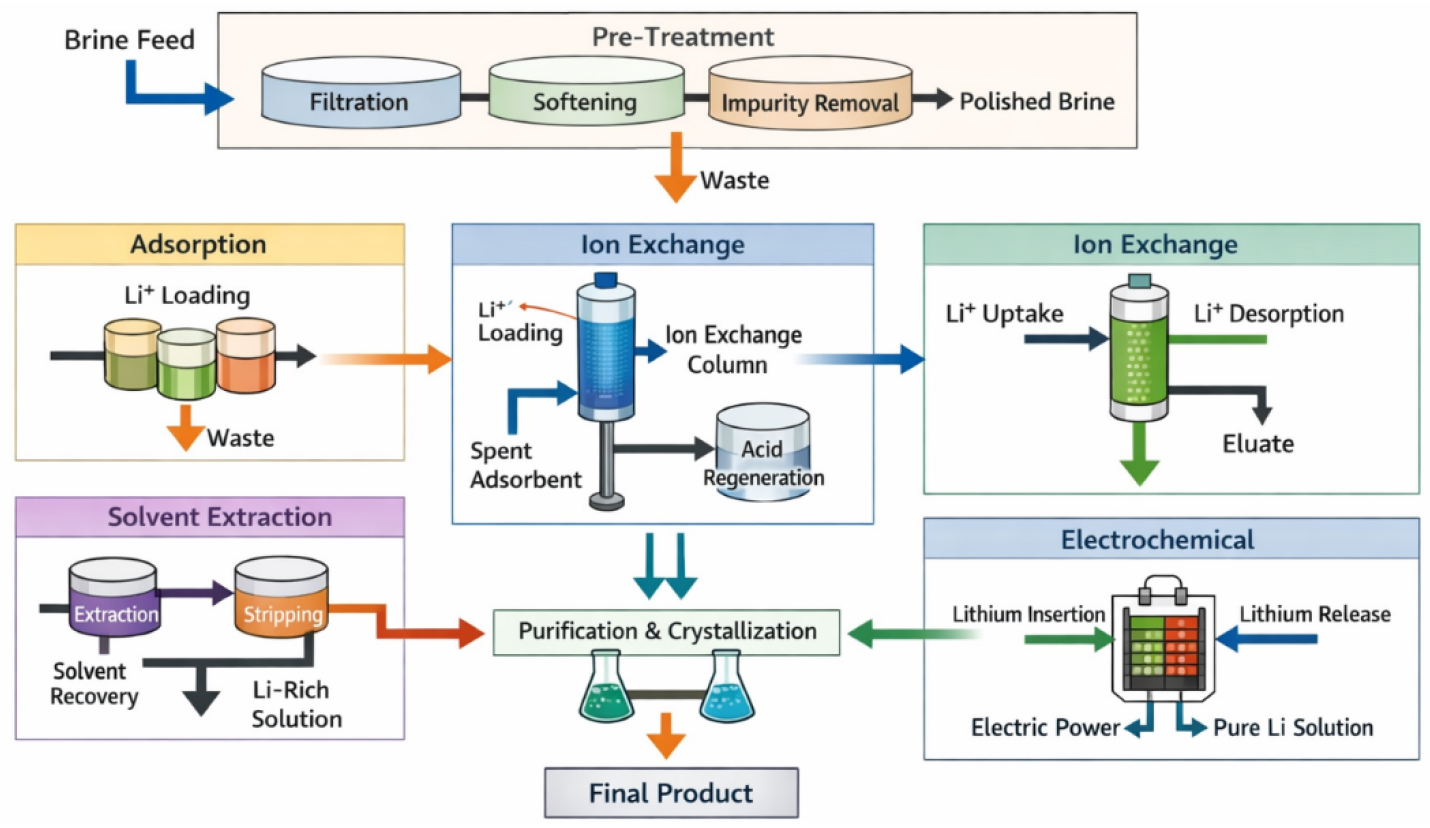
No single DLE pathway is universally optimal across all brine chemistries and resource settings. In practice, industrial lithium recovery increasingly relies on hybrid process architectures in which multiple separation mechanisms are combined to balance recovery, selectivity, purity, and operational stability6,7,9). This trend reflects the fact that primary lithium capture, impurity rejection, eluate concentration, and battery-grade product purification are often best achieved by different unit operations rather than by a single extraction step.
For example, adsorption or ion exchange may be used as the primary lithium-capture stage, while solvent extraction, membrane concentration, precipitation, or electrochemical polishing may be employed downstream to remove residual impurities and achieve final product specifications. Such combinations reduce the burden on any single unit operation and allow the flowsheet to be adapted to different feed chemistries.
Fig. 1 summarizes representative hybrid DLE concepts reported in the literature6,7,9). In generalized terms, these flowsheets begin with pretreatment stages such as filtration, pH adjustment, silica control, or removal of suspended solids. Lithium is then selectively captured using adsorption or ion-exchange media, after which the sorbent is regenerated to produce a lithium-rich eluate. Downstream polishing may involve solvent extraction, membrane separation, selective precipitation, or electrochemical purification depending on target purity and impurity profile. The increasing prevalence of hybrid flowsheets highlights an important conceptual point: DLE should not be viewed solely as a single extraction technology, but as a family of process strategies in which different selective mechanisms are combined according to resource context.
6. Industrial Practice and Case Notes
6.1. Adsorption-centered industrial flowsheet: Lilac–Kachi case
Fig. 2 illustrates a representative adsorption-centered DLE flowsheet, as exemplified by publicly disclosed information on projects such as the Kachi salar operation developed by Lake Resources in collaboration with Lilac Solutions16,17,20). In this configuration, raw brine is first subjected to pretreatment in order to remove suspended solids and control feed chemistry before entering packed columns containing lithium-selective adsorption media. Once lithium loading is completed, the depleted brine is returned to the salar, and the loaded adsorbent is regenerated using an eluent to produce a concentrated lithium-bearing solution.
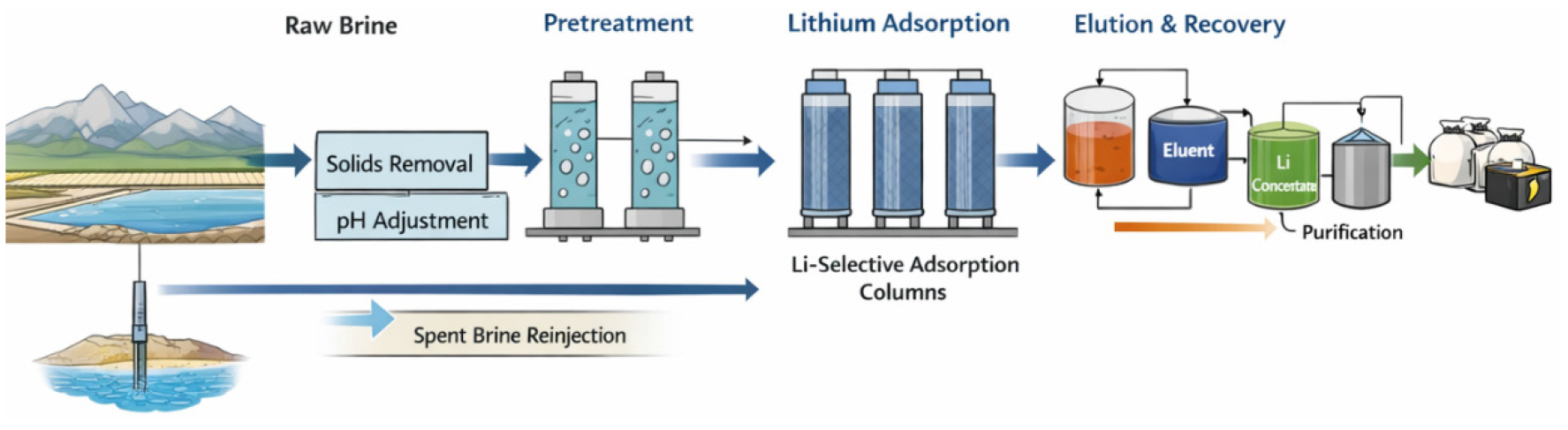
The industrial relevance of this configuration lies in its modularity. Column-based adsorption systems can in principle be scaled by parallelization rather than by expansion of massive evaporation-pond infrastructure, allowing shorter process residence times and potentially lower surface footprint. However, this approach also introduces operational sensitivities related to pretreatment reliability, adsorbent stability, eluent management, and long-term cycle performance. These issues underscore the importance of field validation in industrial DLE deployment.
6.2. Hybrid adsorption–solvent extraction flowsheet: Chinese salar operations
A second important industrial model is the hybrid adsorption–solvent extraction flowsheet reported for certain Chinese salar operations. In such systems, adsorption or ion-exchange units first concentrate lithium from brine into an intermediate eluate, which is then subjected to solvent extraction in order to remove residual alkali and alkaline-earth impurities before final lithium conversion.
Fig. 3 presents a generalized hybrid flowsheet representative of lithium recovery operations reported for Chinese salars, as summarized in review and industry literature11,18). In this approach, adsorption or ion-exchange units are employed as the primary lithium capture step, producing a concentrated lithium-bearing eluate. This intermediate stream is subsequently treated by solvent extraction to remove residual alkali and alkaline-earth impurities and to achieve battery-grade lithium specifications.
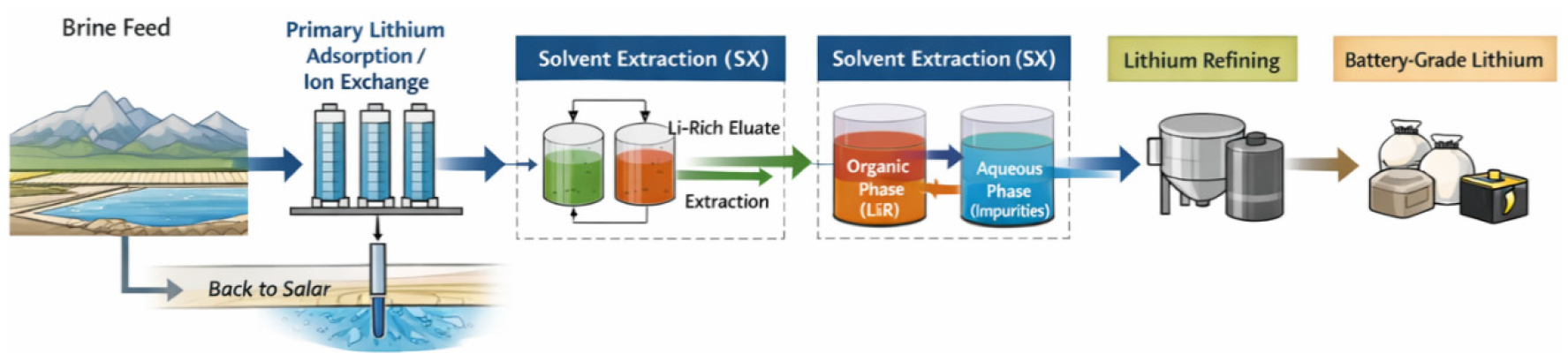
Reviews indicate that such hybrid adsorption–SX flowsheets have been implemented at industrial scale, demonstrating high product purity and stable operation under high-throughput conditions11,18). At the same time, the integration of solvent extraction introduces additional complexity related to solvent management, phase separation, and extractant degradation, underscoring the trade-off between purity enhancement and operational burden. This case highlights why solvent extraction is rarely used as a standalone DLE technology but instead functions as a downstream polishing step in integrated industrial systems.
Taken together, these examples show that current industrial practice does not favor a single universal DLE route. Rather, it favors resource-specific process integration in which lithium capture and impurity removal are separated into complementary steps.
7. Selectivity, pH Control, and Fouling
7.1. pH coupling and manganese dissolution
Lithium intercalation into λ-MnO2-based adsorbents intrinsically couples lithium uptake with proton release, resulting in gradual acidification of the contacting solution. This behavior can be represented by the reversible proton–lithium exchange reaction:
As cycling proceeds, progressive pH drift toward acidic conditions correlates with elevated manganese concentrations in eluates and with structural signatures of lattice degradation, including loss of crystallinity and diminished lithium capacity. Field and laboratory studies consistently report that uncontrolled pH excursions accelerate Mn dissolution and shorten usable adsorbent lifetime8,13,21,22,23).
Operation under near-neutral buffered conditions increases resistance to pH drift by moderating proton accumulation at the solid–liquid interface. In parallel, nanometric surface-stabilization layers—most commonly Zr- or Ti-based coatings—suppress manganese dissolution while preserving lithium transport pathways within the host lattice8,13,21,22,23). When combined with appropriate adsorption–regeneration cycling protocols, these measures significantly extend practical capacity retention under repeated operation, underscoring that pH control is a system-level constraint rather than a materials property alone.
7.2. Multivalent-ion interference and silica fouling
In natural brines, magnesium and calcium reduce effective lithium selectivity through competitive uptake and through precipitation as hydroxides or carbonates during concentration, regeneration, or pH adjustment. These processes consume active sites, increase pressure drop, and degrade mass-transfer efficiency. In parallel, dissolved silica and organic species accumulate as adherent surface layers that hinder lithium diffusion into and out of sorbent particles, progressively lowering apparent capacity and kinetics8,11,27).
Operational mitigation strategies reported in the literature include upstream guard beds, dosing of chemically compatible antiscalants, periodic back-flushing, and in-line chemical control tied to pH or oxidation–reduction potential. The optimal configuration is inherently site-specific and benefits from brine-resolved speciation models coupled with pilot-measured kinetics, reinforcing the importance of early-stage field testing in DLE project development8,11,27).
Recent evidence from electrochemical lithium extraction studies on geothermal brines also shows that mineral scaling is not limited to adsorption columns. Fe(II) can severely degrade electrode performance through formation of iron (hydr)oxide scale layers, while silica and Mn(II) also contribute to surface deposition and operational instability. These findings reinforce the broader conclusion that impurity-specific pretreatment is indispensable across multiple DLE platforms, not only for sorbent protection but also for preserving selectivity and cycle efficiency under real brine conditions27).
8. Environmental performance: Life-cycle assessment
Life-cycle assessment (LCA) studies of brine-based lithium production consistently demonstrate strong sensitivity to methodological choices, particularly the definition of functional units and system boundaries8,9,10). Reported environmental intensities depend critically on whether pre-concentration, DLE unit operations, downstream purification, and refining steps are fully included in the assessment framework8,10).
Recent regionalized modeling indicates that electricity mix, plant scale, brine chemistry, and the effectiveness of reagent and water recycling dominate greenhouse-gas emissions and cumulative energy demand for DLE systems8,9,10). In this context, co-location with geothermal power and heat—as pursued in Japan—offers a clear pathway to reduce carbon intensity and overall environmental footprint, whereas deployment in coal-dominated grids can substantially erode the comparative advantages of DLE relative to conventional supply routes8,10).
Across published cases, DLE facilities exhibit markedly smaller land occupation and reduced hydrological disturbance compared with large evaporation-pond systems, although these benefits must be evaluated alongside energy consumption and chemical inputs required for pretreatment and regeneration8,9,10). Accordingly, LCA should be treated not as a supplementary metric but as a central criterion for technology evaluation, especially under policy environments that increasingly reward traceability and lower-carbon supply chains.
9. Policy and strategy for East Asia
Recent policy developments have begun to reshape the strategic calculus for lithium supply chains. The European Union’s Critical Raw Materials Act (CRMA), enacted as Regulation (EU) 2024/1252, establishes diversification targets, strategic-project designation, and explicit benchmarks for domestic and allied midstream capacity28). In parallel, the United States Inflation Reduction Act (IRA) links consumer incentives for electric vehicles to compliant sourcing, processing, and recycling pathways, effectively rewarding supply chains that demonstrate geographic diversification and environmental credibility29).
For East Asia, and Japan in particular, these frameworks create both constraints and opportunities. Policies that bridge the gap between pilot-scale validation and commercial deployment—especially in geothermal settings—are essential to lower financing risk and accelerate scale-up. Standardization of performance metrics for lithium selectivity, cycle life, and manganese dissolution, coupled with mandatory and transparent LCA reporting, would further align technical development with regulatory expectations8,9,10).
Japan’s emerging dual-track strategy illustrates a pragmatic response to this policy landscape. Overseas salar pilots provide access to higher lithium concentrations and operational learning, while domestic geothermal deployments enable integration with low-carbon power, reinjection compliance, and established midstream materials capacity10,14,15,27,29,30). When linked to refining and recycling hubs, such an approach embeds circularity and resilience into the regional supply chain, offering a transferable template for DLE deployment across East Asia under tightening global policy constraints.
More broadly, East Asia’s comparative advantage may not lie in conventional lithium mining itself, but in the integration of advanced extraction, refining, precursor manufacturing, and battery-material processing. In that sense, DLE technologies—particularly those compatible with geothermal or lower-grade resources—could play a disproportionately important strategic role in the region.
10. Outlook and conclusions
Direct lithium extraction has progressed from bench-scale studies to pilots and early deployments. With appropriate pH control and surface stabilization, λ-MnO2 adsorption demonstrates robustness under geothermal conditions; ion exchange appears attractive for salar resources; solvent extraction is already integrated at industrial scale in China; and electrochemical systems continue to advance8,14,21,22,23).
The immediate imperatives are standardized and transparent datasets for selectivity, durability, and environmental performance, site-specific pretreatment and hydrodynamic optimization, and financial structures capable of carrying credible pilots across the bankability threshold. In other words, the next stage of DLE development will depend less on conceptual promise and more on reproducible field data and process integration.
For East Asia, alignment of policy instruments with field-validated chemistry and domestic midstream capacity will determine whether DLE matures into a durable pillar of the lithium supply chain8,10,14,15,30,31). Rather than replacing conventional lithium extraction entirely, DLE is more likely to evolve as a complementary portfolio of technologies matched to specific resource contexts. Within that portfolio, manganese-based adsorbents remain especially significant because they offer both high lithium selectivity and a rich case study in the interaction between material degradation, solution chemistry, and industrial process design.
In particular, recent advances in coated and composite manganese-based ion sieves suggest that the historical trade-off between lithium selectivity and structural durability may be partially mitigated through surface engineering and immobilization strategies, improving the prospects for continuous-flow and field-scale deployment21,22,23).