

1. Introduction
2. Commercial LIB recycling processes in Korea
3. New challengers and their strategies
4. Conclusions
1. Introduction
In the 21th United Nations Framework Convention on Climate Change Conference of the Parties (UNFCCC COP21), the Paris Agreement was adopted on 12 December 2015 and entered into force on 4 November 2016, and its goal is to limit global warming to 1.5 °C1). The Korean government has declared Carbon Neutrality in 2020, and announced ‘Carbon Neutrality 2050 Scenario’ prepared by the 2050 Carbon Neutral Green Growth Committee2), which was established based on the ‘Act On Carbon Neutrality And Green Growth For Coping With Climate Crisis3).’ In this scenario, the use of electric vehicles has been encouraged by the Korean government because one of main goals is to reduce the carbon footprint in a transport field.
The Korean government announced the development strategy for future vehicle industry in 2019, where the government set the share of fuel cell and battery electric vehicles at 30% until 2030. Another development strategy entitled ‘2030 secondary battery industry development strategy’ (K-battery strategy) was prepared by the Korean government. Three detailed strategies are securing unrivaled 1st-technology, building a global leading base, and expanding the secondary battery market, where the market also contains battery recycling industries. The recycling industries can be classified into remanufacturing and recycling industries, and the representative products are the batteries for energy storage system (ESS) from remanufacturing processes and metal sulfates such as CoSO4 and NiSO4 from recycling processes, respectively.
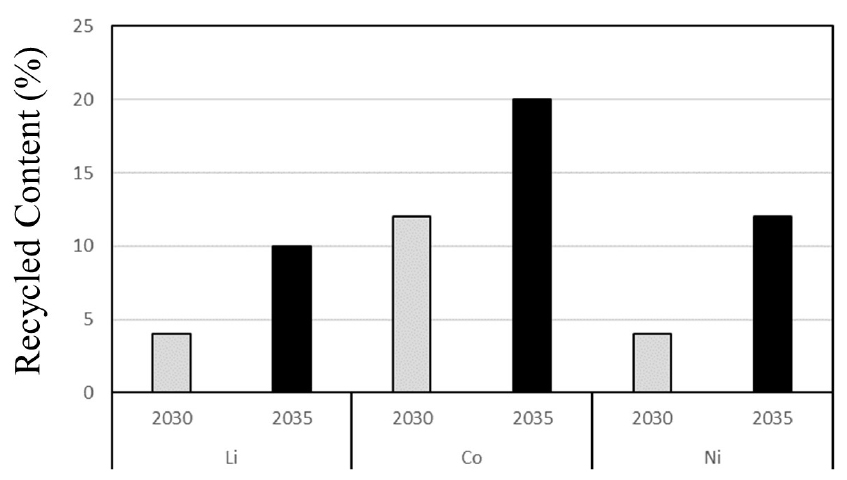
A new EU regulatory framework was announced in 2021, and it includes a recycled-content declaration requirement4). This regulation would apply to various batteries such as industrial batteries and electric vehicle batteries, which contain lithium, cobalt, nickel, or manganese in active materials. As shown in Fig. 1, mandatory minimum levels of recycled content would be set to 12% cobalt, 4% lithium, and 4% nickel in 2030, increasing to 20% cobalt, 10% lithium, and 12% nickel in 20354). These regulation makes vehicle and battery manufacturers aware of the importance of battery recycling.
The Korea has been found as a representative resources-poor country5,6). Furthermore, battery minerals such as cobalt and nickel are limited to a few countries, e.g., 71% of cobalt is produced in the Democratic Republic of the Congo, and nickel is mainly produced in Indonesia7). Therefore, the Korean government has recognized the importance of establishing a secure supply-chain of critical mineral for the domestic battery industries by securing critical minerals such as Li, Co, and Ni through recycling, and the government has supported small business recycling companies by R&D funding8). In the present article, the commercial lithium ion battery (LIB) recycling processes in Korea were summarized, and new technological and industrial challenges were discussed to suggest new direction for LIB recycling.
2. Commercial LIB recycling processes in Korea
The first LIB recycling company in Korea is Sungil Hitech Co., Ltd. and after establishing a LIB recycling factory in 2008 and operating a pretreatment process called ‘Recycling Park’, it has operated a hydrometallurgical process called ‘Hydro Center’ since 2011 to produce metal sulfate supplied to battery manufacturers. This recycling process was developed together with Korea Institute of Geoscience and Mineral Resoures (KIGAM) funded by ‘Resources Recycling R&D Center’ project of Korean Government8). Therefore, the brief summay of the research conducted by KIGAM is as follows.
Early lithium-ion battery recycling studies were conducted on lithium cobalt oxide (LCO) cathode materials. Lee and Rhee proposed the LCO anode recycling process, in which, after a two-step thermal and mechanical treatment, the anode concentrate was leached in 1 M HNO3 solution with H2O2 and then lithium and cobalt were recovered by the amorphous citrate precursor process9,10). The H2O2 in this leaching process was used as a reducing agent, which could reduce the oxidation state of metals from +3 to +24). The reductive leaching system was changed from HNO3 with H2O2 to H2SO4 with H2O211,12).
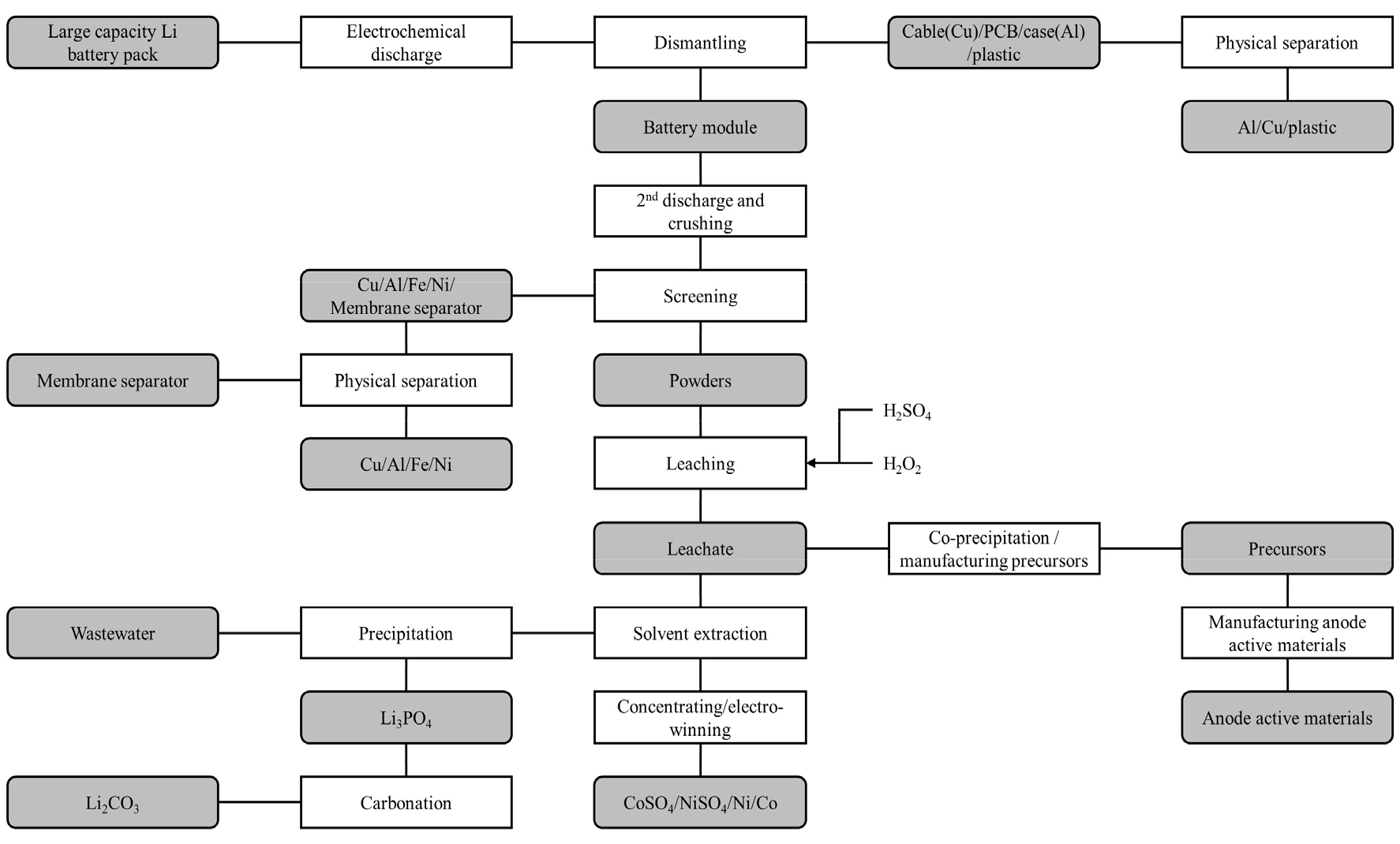
As demand for lithium-ion batteries increased, it was expected that the use of NCM (nickel-cobalt-manganese) type cathode material increases. The reductive leaching process can be also applied to NCM cathode recycling process, but cobalt, nickel, and manganese must be separated into each metal component13,14,15,16,17). The separation can be achieved by solvent extraction processes using Cyanex 27213), PC88A and Versatic 10 acid15), or Versatic 10 acid and LIX 84-I16). Fig. 2 shows a recycling process based on the previous studies summarized above8).
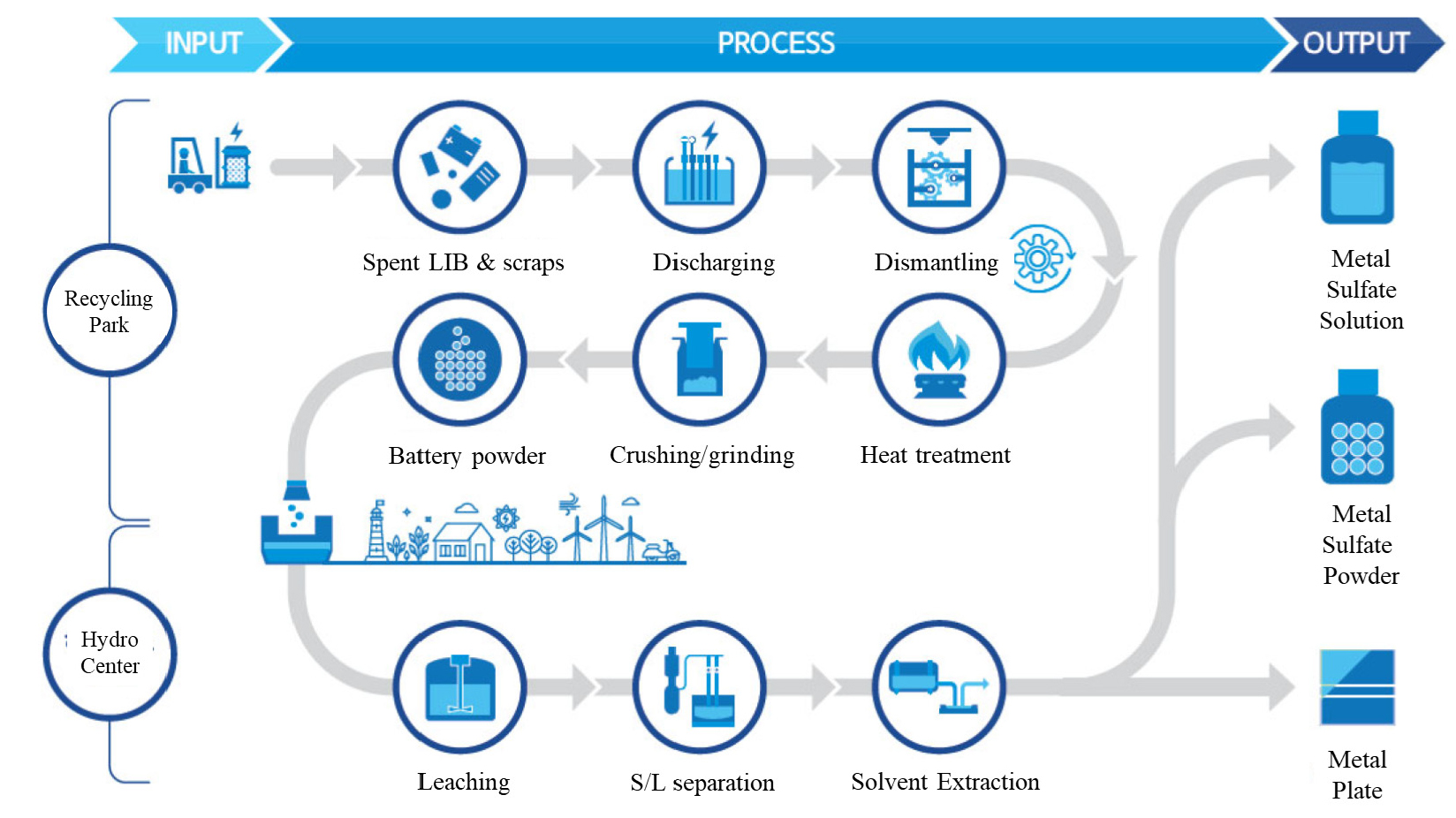
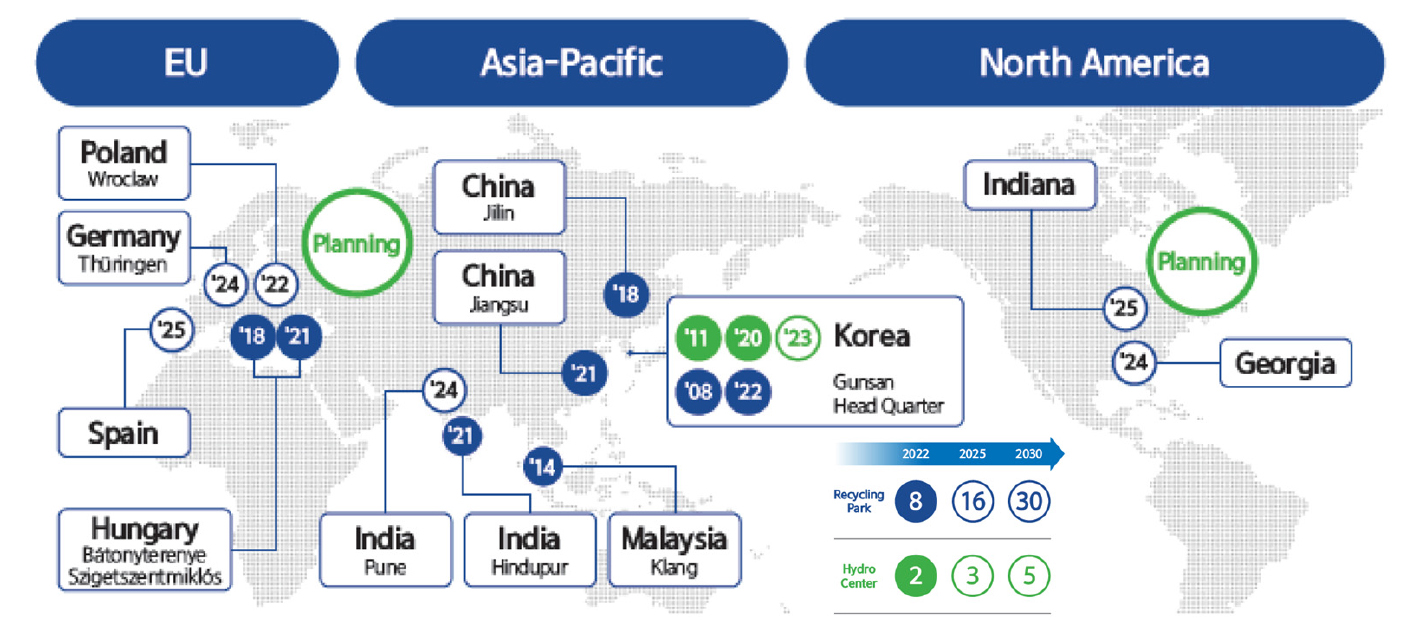
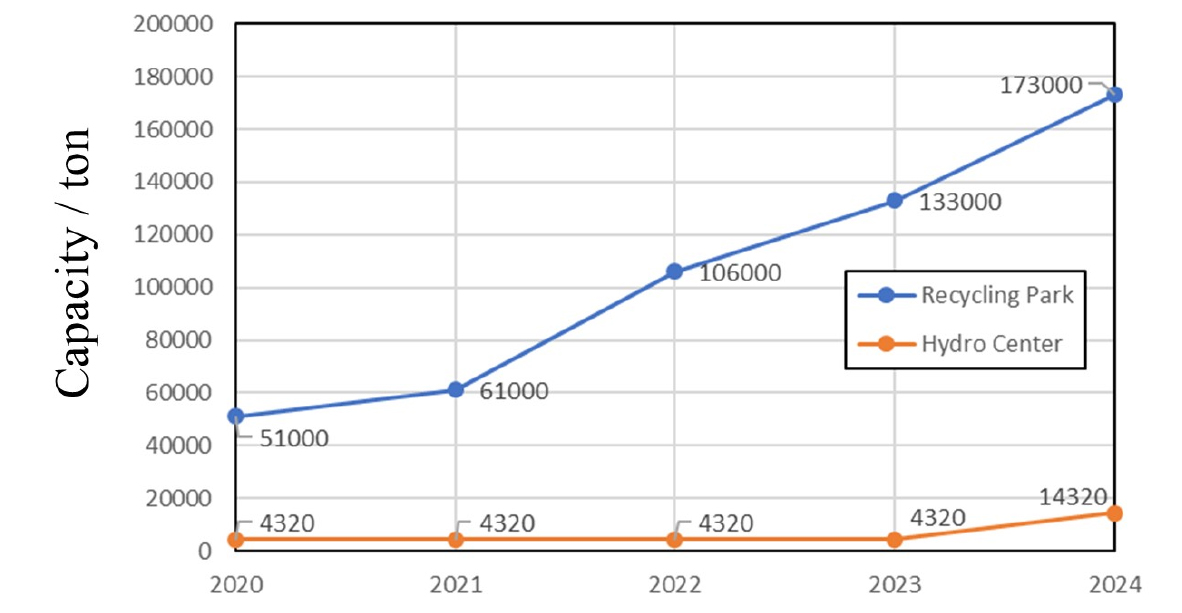
The SungEel Hitech Co. Ltd. has continuously improved the recycling process for last ten years, and the process was summarized as shown in Fig. 318). The process is devided into recycling park and hydro center. The recycling park consists of discharging, dismantling, heat treatment, and crushing/grinding for producing battery powder, which is the mixture of anode and cathode powders. In the hydro center, the battery powder is dissolved in sulfuric acid with hydrogen peroxide, and then separated by solvent extraction into each metal component. SungEel Hitech Co. has the plan to construct 30 recycling parks and 5 hydro centers around the world as shown in Fig. 4. The hydro center in Gunsan headquarter in Korea produces nickel and colbat compounds by receiving the batter powders from 8 recycling parks. The capacity of recycling park and hydro center is plan to be 173,000 ton and 14,320 ton, respectively, as shown in Fig. 5. Two hydro centers will be constructed in North America and Europe, and the capacity will reach 20,080 ton/year.
3. New challengers and their strategies
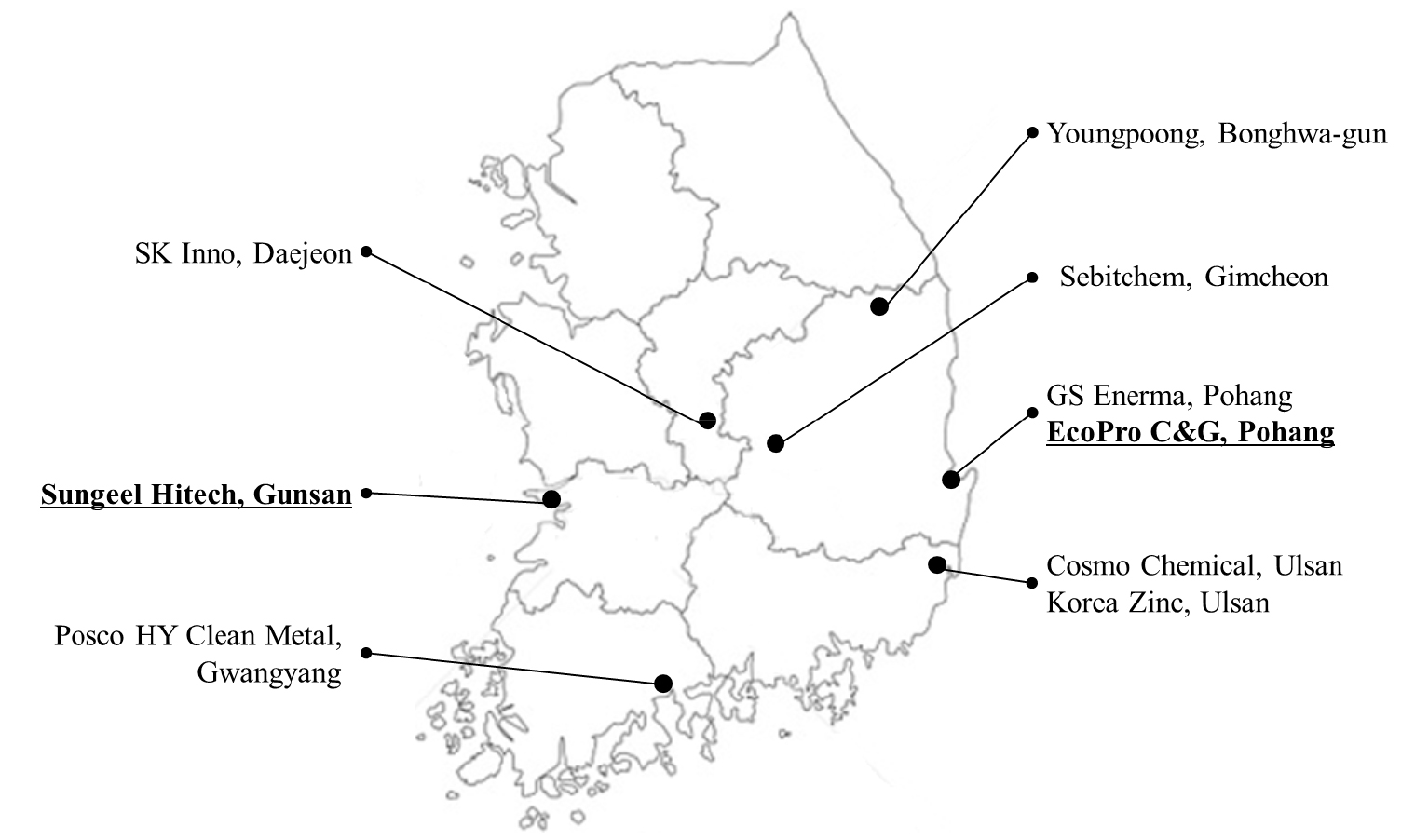
As the importance of the battery mineral supply chain has been recognized, many companies in Korea have increased their interest in the battery recycling industry. The companies and their location are summarized in Fig. 6. The representative challeger is EcoPro C&G (clean and grenn) Co., a subsidiary of EcoPro Group. As shown in Fig. 7, EcoPro group built the closed loop system for lithium ion battery manufacturers, in which EcoPro CNG provides metals, obtained from spent LIB and scraps, to EcoPro Materials and EcoPro innovation, respectively19). The EcoPro Materials and EcoPro innovation received the metal sources from mineral resources as well as EcoPro CNG.
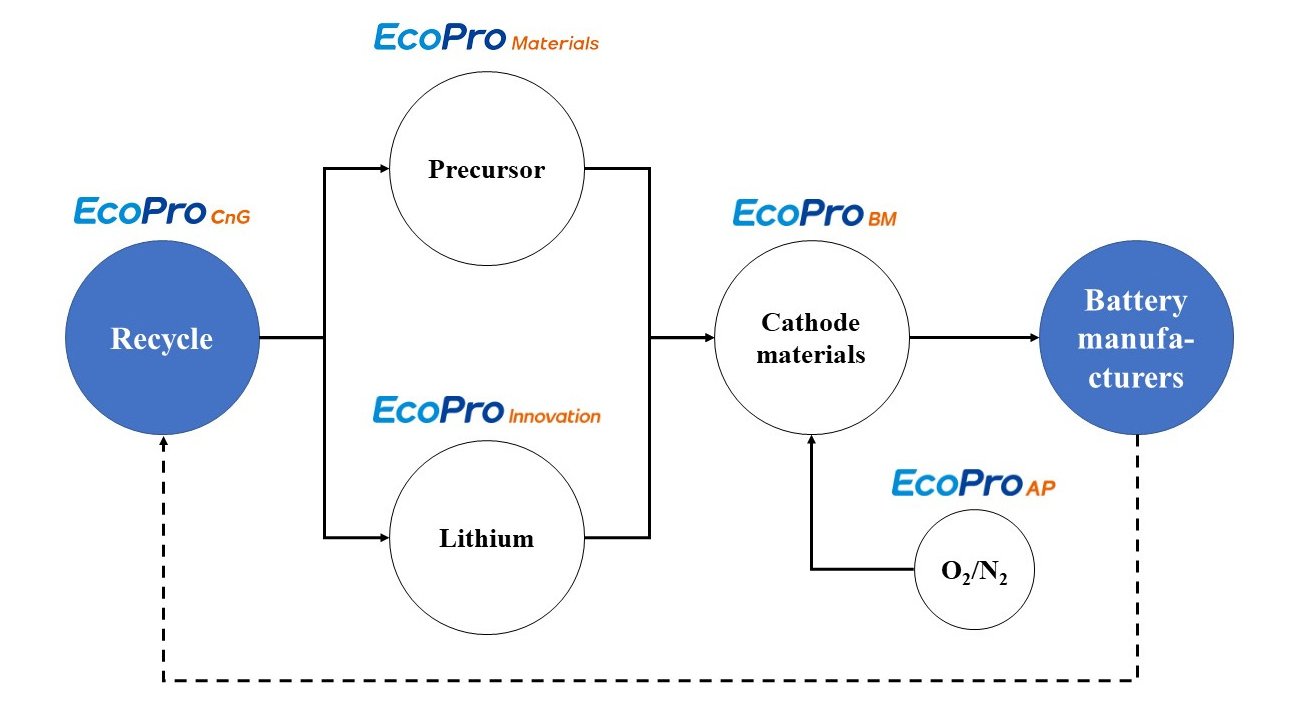
In the conventional recycling processes, main final products are metal sulfate such as NiSO4 or CoSO4. However, since EcoPro CNG can supply their product directly to EcoPro Materials, a precursor manufacturer, EcoPro CNG can deliver the nickel and cobalt as metal solution. Therefore, as shwon in Fig. 3, SungEel Hitech now supplies the metal sulfate solution to manufacturers.
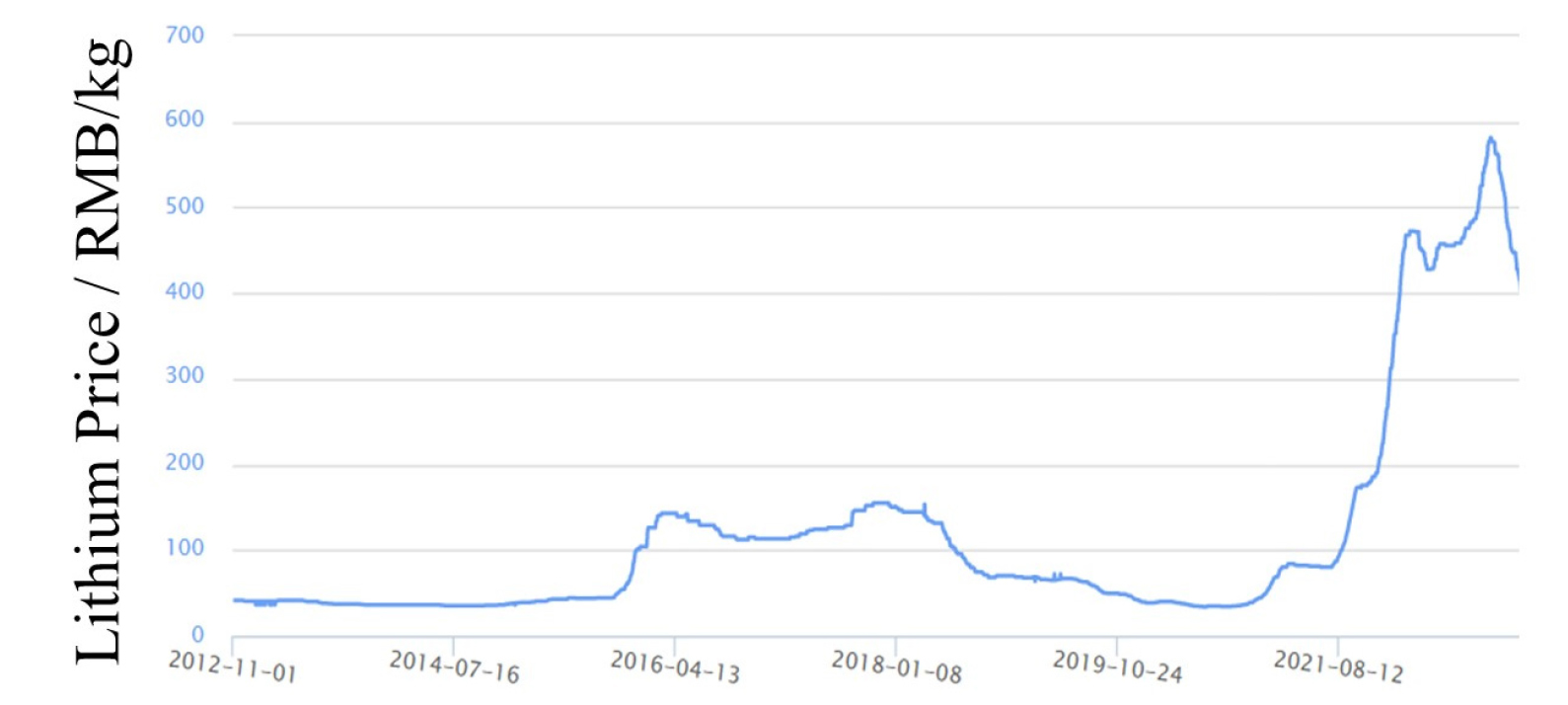
Many new challengers developed their LIB recycling process considering the recyling process developed by KIGAM and SungEel Hitech Co. However, when the recycling process of SungEel Hitech Co. was developed, the recovery of lithium is not an important issue because lithium prices is relatively low as shown in Fig. 8. The price is only 41 RMB/kg in November, 2012, but it increased rapidly after 2020, rising to 575.5 RMB/kg in Nomvember, 2022. Therefore, SungEel Hitech Co. added a Li recovery process after the recovery of Ni and Co by solvent extraction process. Although the new challengers didn’t disclose their new LIB recycling processes, it has benn found that lithium is recovered before nickel and cobalt in a new recycling process.
Sebit Chem Co. Ltd has operated the recycling process after 2017 and supply the metal solution to battery manufacturers. Posco HY Clean Metal Co., GS Enerma, and Cosmo Chemical Co. are building the recycling facilities. The Posco HY Clean Metal Co. is a joint venture between Posco Co. and Huayou Co. SK Innovation Co. and Youngpoong Co. are now testing their pilot plants based on their own recycling processes. Most of LIB recycling processes are based on the hydrometallurgical processes, but the new recycling process by Youngpoong Co. consists of pyrometallurgical processes, and the pilot plant is now operated with 2,000 ton/year.
Many joint ventures were announsced for LIB recycling; LG Energy Solution and GM, POSCO and GS, SK Innovation and SungEel Hitech, LG Energy Solution and Huayou Cobalt, LG Chem and Korea Zinc, LG Energy Solution and KEMCO. Other battery manufactures such as Samsung SDI and SK ON also develop their LIB recycling processes. All companies are building or have plans to construct recycling facilities with a capacity of 10,000 ton/year or more, and there is an increasing concern about the competition between LIB recycling companies.
4. Conclusions
It is important to establish a stable supply chain of metals such as Li, Ni, and Co for the continuous development of the domestic battery manufacturing industry. Therefore, the Korean government has supported small business recycling companies by R&D funding. SungEel Hitech Co. has run the LIB recycling facility sucessfully for last 10 years. New LIB recycling processes were proposed and constructed, where some improvement was achieved; lithium is recovred before Ni and Co, and metal sulfate solution is supplied directly to manufactures. However, the new recycling processes should overcome the following issues.
1.The conventional recycling processes have treated the scraps obtained from battery manufactures. However, as the end of life EV will increase, the EV contaminated with impurities will be treated.
2.The conventional recycling processes have treated only LCO (lithium cobalt oxides) or NCM (nickel-cobalt-manganese) battery, but, as the use of LFP (lithium iron phosphate) in EV increases, the mixed batteries of LCO, NCM, and LFP should be treated by the recycling processes.
3.The manufacturing technologies and processes for LIB are continuously being improved. New additives are investigated and developed to improve the stability of LIB. These kinds of additivies act as impurities in the recycling processes.